How to Build Backlinks for a Brand-New Website with Zero Authority in 2026
Starting a new website is exciting. Getting your first backlinks? That's where most people hit a wall. Without domain authority, even great content can feel invisible, and traditional link building advice assumes you already have something to leverage. This guide gives you a real starting point, from your very first link to a process you can scale.
Why New Websites Struggle to Get Backlinks
Getting backlinks is a credibility problem. Most site owners who could link to you will check your domain first. If your site is brand new with no traffic, no backlinks, and no established content, you look like a risk rather than a resource.
It's a classic catch-22: you need links to rank, and you need to rank to attract links. But every authoritative site you see today started from zero. The difference is that the ones who broke through understood that early link building is a different game than the one experts describe.
The Trust Barrier
Domain authority (DA) and domain rating (DR) are third-party scores that estimate how trustworthy a site is based on its backlink profile. A brand-new site starts at zero. That doesn't mean your content is bad. It means you haven't yet built the signal that tells other sites you're safe to link to.
The good news: trust is earned quickly when you target the right link sources first. You don't need 100 links. You need 5-10 genuinely good ones, and the right strategy to get them.
Why Most New Site Owners Make This Harder Than It Needs to Be
Most beginners either wait for links to appear naturally (they won't) or jump straight to cold outreach with nothing to offer (it won't work). The answer sits between these two approaches: a deliberate, sequenced strategy that builds your credibility incrementally.
How Do You Get Your First Backlinks Without Domain Authority?
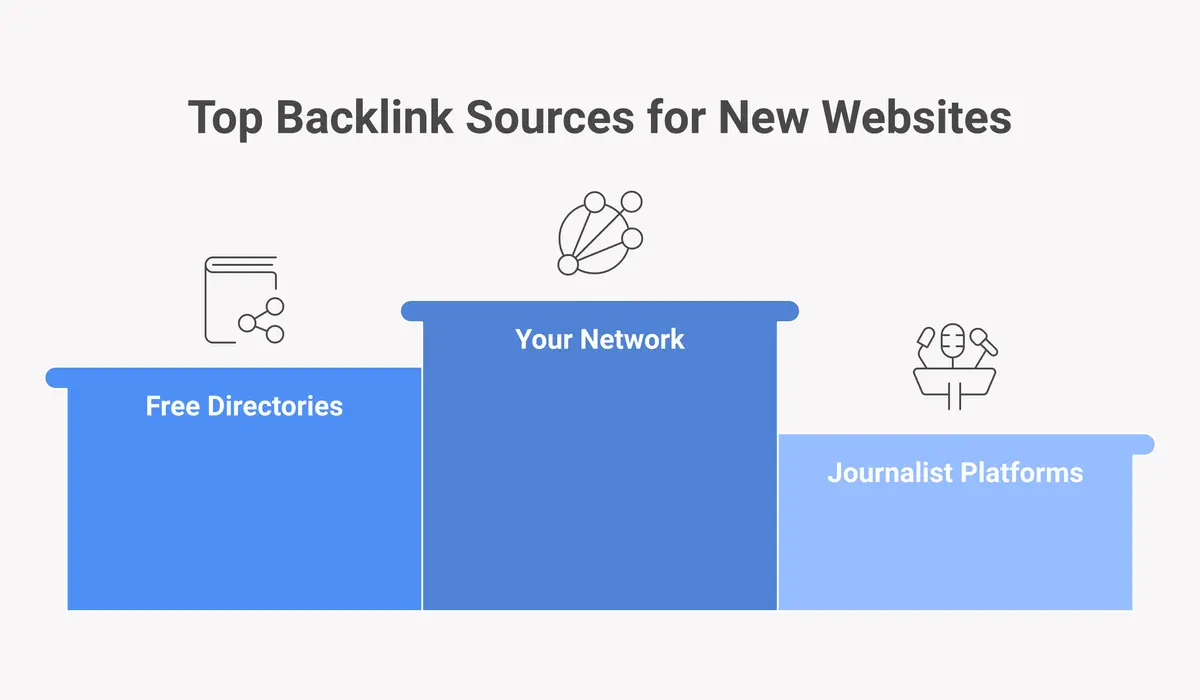
Your first backlinks should come from sources that don't require you to already be credible: your own network, free directories, and journalist platforms. These are lower competition, easier to obtain, and still valuable when they come from relevant, indexed sites.
Start With Your Immediate Network
Think about everyone who already knows and trusts you: colleagues, business partners, past clients, suppliers, and friends with websites. Ask if they'd be willing to mention your new site in a relevant context. These aren't charity links. They're warm introductions.
Don't ask for a generic "check out my site" mention. Point them to a specific piece of content that fits something they've written or are writing about. Make it easy for them to say yes.
Claim Free Directory and Profile Listings
Industry directories, Google Business Profile, Crunchbase, LinkedIn company pages, and niche-specific directories all offer free, indexed backlinks. These aren't going to move your rankings dramatically, but they establish your site as a real entity in Google's eyes.
Research consistently shows that even basic directory listings contribute to trust signals for brand-new domains. Claim every relevant one you can find.
HARO Link Building: Get Editorial Links from High-Authority Media
Help a Reporter Out (HARO), Qwoted, and SourceBottle connect journalists with expert sources. Sign up, monitor daily requests in your niche, and respond to relevant queries with a short, expert quote. When your quote is published, you typically earn a link from a high-authority news or media site.
These are some of the most valuable early backlinks you can get. They come from established domains, they're editorial, and they don't require any prior authority on your part.
What Content Actually Attracts Links When You Have No Authority?
Not all content earns links. In your early days especially, you need content that gives other site owners a clear reason to reference you. Generic blog posts won't do it. These three content formats punch above their weight for brand-new sites.
Original Data and Research
If you can survey your audience, analyse publicly available data, or run an original study, you have something no one else has. Other writers need to cite their claims. If your data supports a point they're making, they'll link to you whether you have 0 or 10,000 backlinks.
It doesn't need to be a large-scale study. A survey of 50-100 people in your niche, presented clearly, can generate links from major industry publications.
Comprehensive Resource Pages
A resource page is a single piece of content that aggregates the best tools, guides, examples, or frameworks on a specific topic. Editors and bloggers link to these because they save their readers a step. If your resource is genuinely comprehensive, it attracts links even from sites with much higher authority.
Visual Assets
Infographics and process diagrams get shared and embedded, and embedding typically includes a link back to the source. Sites are more likely to use your visual than to recreate it from scratch. This is one of the few content formats where zero authority is almost irrelevant.
Focus on visuals that explain complex processes simply. The more useful and shareable the asset, the more organic links it generates over time.
What Is the Best Outreach Strategy for a Zero-Authority Site?
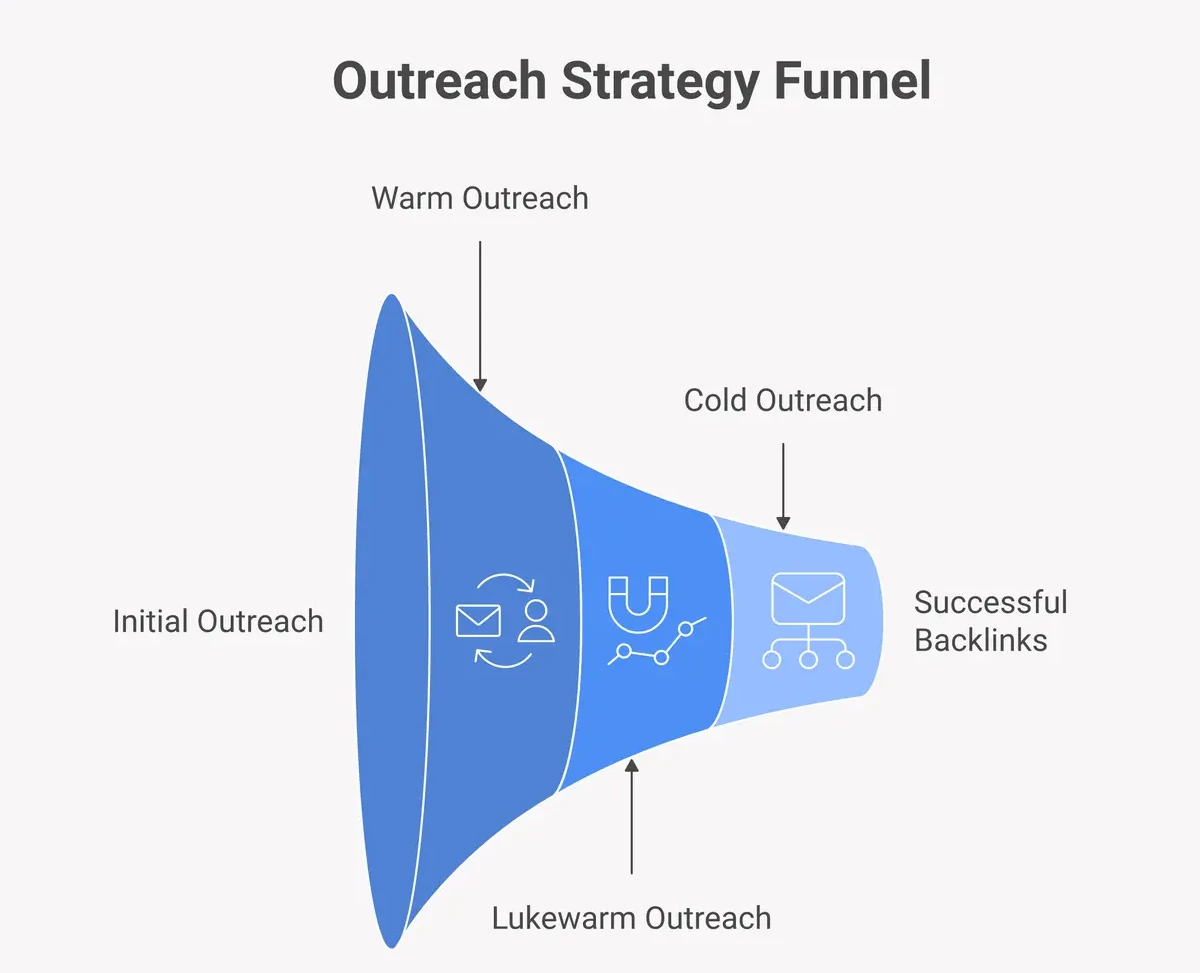
The best outreach strategy for a new site runs warm-to-cold: start with people who already know you or your content, then expand to prospects who have a clear reason to link to you, and only then attempt cold outreach at scale. Reversing this order wastes time and burns bridges.
Backlink Gap Analysis: Find Sites Already Linking to Competitors
A backlink gap analysis identifies sites that link to your competitors but not to you. These sites have already decided your topic is worth linking to. All you need to do is give them a better or complementary reason to add your site too.
Tools like Ahrefs, Semrush, and Moz all have backlink gap features. Export a list of sites linking to 2-3 competitors, remove any that are irrelevant, and work through them methodically.
Write Outreach Emails That Earn Responses
Cold outreach on a new site gets a 3-8% response rate on average. You can improve this significantly with personalisation. Reference a specific article they've written. Explain precisely where your content adds value or fills a gap in something they've already published.
Avoid generic scripts. One well-researched email is worth ten templated ones. Follow up once after 5-7 days if you don't hear back, then move on.
Unlinked Brand Mention Reclamation
As your site grows, people will mention it without linking. Use Google Alerts or a tool like Mention to track your brand name and key articles. When you find an unlinked mention, reach out politely and ask the author to add the link. These conversions are close to 100% because the person already likes your content enough to mention it.
You can also explore link exchange strategies, where mutual mentions between complementary sites can grow both parties' authority simultaneously.
How to Use Guest Posting for Backlinks and Domain Authority
Guest posting is one of the fastest ways to build backlinks for a new site, as long as you approach it correctly. The goal is to publish genuinely useful content on relevant sites in your niche, earn a natural author bio link, and build your reputation at the same time.
Target Sites One Step Above Your Current Level
Don't start by pitching the biggest names in your industry. They receive hundreds of pitches weekly and almost never accept submissions from unknown authors. Start with sites that are slightly more established than yours but still approachable. Build your portfolio of published guest posts there first.
Once you have 3-5 published pieces, you have proof of quality. That's what larger sites want to see before they invest editorial time in you.
Pitch Ideas, Not Articles
The most common mistake in guest posting outreach is sending a fully written article unsolicited. Most editors ignore these because they haven't bought into the topic yet. Instead, send a short pitch: one paragraph explaining who you are, a topic idea with a working title, and 2-3 bullet points on what the article will cover.
This respects the editor's time and invites a conversation rather than demanding a decision on a finished piece.
Avoid Guest Post Mills
If a site accepts guest posts from anyone, charges a fee, or publishes content that has nothing to do with your niche, skip it. Google's spam policies explicitly target link schemes involving large-scale guest posting on low-quality sites. A link from a spammy site does more harm than no link at all.
Track, Iterate, and Scale What Works
Link building without tracking is guesswork. Once you have a few tactics in motion, you need a simple system to know what's generating results and what's wasting your time.
Set Up a Basic Backlink Monitoring System
Use Google Search Console (free) to track when new links appear. Add Ahrefs, Moz, or Semrush if budget allows. Check your backlink profile weekly in the early months. You're looking for new links, lost links, and any patterns in what types of content are attracting the most inbound links.
Over time, this data tells you exactly where to double down. If your original data pieces attract 3x more links than your opinion posts, produce more original data.
Build Repeatable Outreach Processes
Once you've found an outreach approach that generates responses, systematise it. Create a simple spreadsheet to track prospects, email sent dates, follow-up dates, and outcomes. Aim for 10-20 new outreach contacts per week once you have solid content to back your pitch.
Consistency over intensity. Five solid outreach attempts per week, every week, outperforms a burst of 50 emails followed by weeks of nothing.
Frequently Asked Questions
How long does it take to get the first backlink for a new website?
With proactive effort, most new sites earn their first few backlinks within 2-4 weeks. Start with your network and free directories on day one. Editorial backlinks from HARO or guest posts typically take 4-8 weeks from first contact to publication.
Is it safe to buy backlinks for a new website?
No. Purchased links from link farms or link brokers violate Google's guidelines and can result in a manual penalty that removes your site from search results entirely. For a brand-new site with no existing authority, a penalty can be nearly impossible to recover from. Organic link building is slower, but it's the only approach that compounds safely.
How many backlinks does a new site need to start ranking?
There's no fixed number. What matters more than quantity is quality and relevance. Backlinko's analysis of 11.8 million Google search results found that the number one result has an average of 3.8x more backlinks than positions 2-10. A handful of high-quality, relevant links will move your rankings more than dozens of low-quality ones.
What is the easiest type of backlink to get for a new website?
The easiest backlinks to get early on are profile links (directories, social platforms, review sites), HARO editorial mentions, and links from your personal network. These require effort but not an established reputation. They're a solid foundation to build on.
Can internal links help while you're waiting for external backlinks?
Yes, but with realistic expectations. Internal links help Google crawl and index your content, and they distribute whatever page authority you do have across your site. They don't substitute for external backlinks, but a well-structured internal linking system means that every new external link you earn benefits more pages, not just one.
How do you increase domain authority for a new website?
The most direct path when learning how to increase domain authority for a new website is to earn backlinks from established, relevant sites. Tools like Ahrefs and Moz calculate domain authority as a function of your backlink profile - the number, quality, and topical relevance of sites linking to you. For a new site, this means starting with foundational links (directories, profiles), then progressing to editorial links through HARO, guest posting, and original research. A handful of high-quality backlinks from authoritative sites will increase domain authority faster than dozens of links from low-quality sources. Consistency over time is what moves the needle.