Types of Backlinks: Every Kind That Matters for SEO in 2026
Not all backlinks are equal, and not all SEO advice explains why. There are many different types of backlinks in SEO, and each one signals something different to Google about your site's authority, relevance, and trustworthiness.
This page covers every type of backlinks that actually matters for SEO in 2026: what each one is, what value it carries, and where the risks are. The final section explains why building a mix of all backlink types is what separates a natural profile from one that eventually gets penalized.
What Are Backlink Types and Why Do They Matter?
Backlink types are categories of inbound links defined by their source, acquisition method, and technical attributes. The most important split is between dofollow and nofollow links: dofollow links pass PageRank directly, while nofollow links use the rel="nofollow" attribute to tell crawlers not to pass ranking credit. Both types appear in natural link profiles, so a healthy mix of both looks organic.
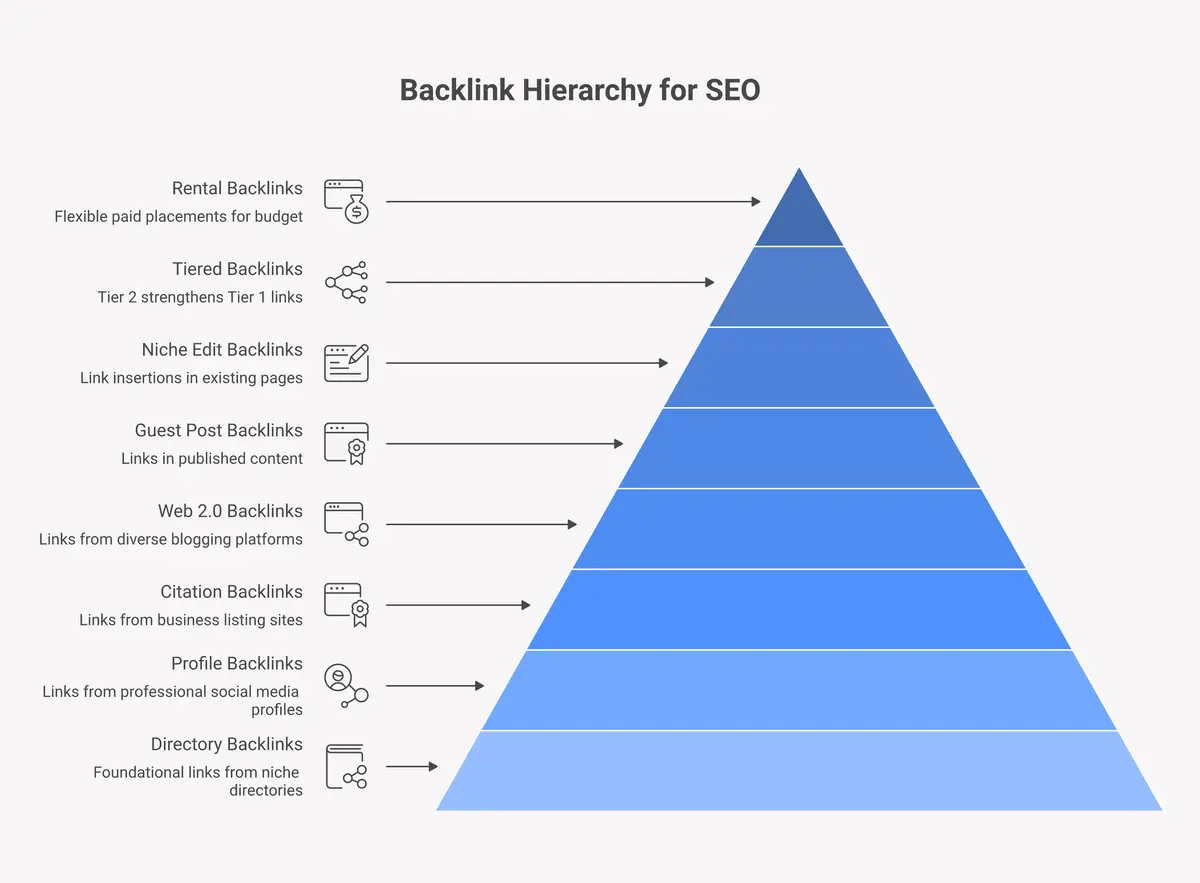
Beyond that split, the main types of backlinks in SEO include directory listings, profile pages, citations, editorial mentions, web 2.0 content, niche edits, tiered structures, and rental placements. Each source type adds a different signal. According to Google's spam policies, links that exist to manipulate rankings through unnatural patterns are a policy violation. A site with links from only one source type looks artificially constructed, regardless of the quality of those individual links.
Directory Backlinks
What they are
Directory backlinks come from web directories, niche directories, local business listings, and specialized index sites like AI tool directories. You submit your site to be listed, and the listing page links back to you. These are among the oldest and most foundational link types on the web.
SEO value
High-authority niche directories pass genuine PageRank through dofollow links. General web directories vary: established ones with editorial review carry real value, while open-submission directories with no quality filter carry less. Our free backlinks database lists hundreds of vetted submission opportunities across both categories.
When to use them
Directory backlinks are the foundational layer of any link profile. They are the fastest legitimate way to build referring domain diversity for a new site. Our directory submission service handles AI directories, niche directories, and general directories as part of a complete campaign.
Profile Backlinks
What they are
Profile backlinks come from social platforms, developer communities, professional networks, and industry forums where your profile page includes a website link. Common sources include GitHub, AngelList (Wellfound), Crunchbase, LinkedIn, Product Hunt, and developer communities like DEV.to.
SEO value
Profile links from high-authority platforms like GitHub (DA 95+) or Crunchbase carry strong domain authority signals. Many are nofollow, but nofollow links from trusted domains still appear in natural link profiles and contribute to brand entity signals. Google uses these to understand what kind of site yours is and where it belongs in the web's topical graph.
When to use them
Profile backlinks are free, fast to acquire, and low-risk. They work best as part of a diverse profile rather than in isolation. For a full breakdown of how to use them, see our guide to profile backlinks and their SEO value.
Citation and NAP Backlinks
What they are
Citation backlinks are mentions of your business Name, Address, and Phone number (NAP) on business listing sites, local directories, and data aggregators. Consistency across all citations matters more than volume: Google uses NAP consistency as a trust signal for local and business authority.
SEO value
Citation links are particularly valuable for local SEO and for any business wanting to signal legitimate presence across the web. Sites like Google Business Profile, Yelp, Bing Places, and industry-specific directories contribute trust signals that generic web directories can't replicate. They tell Google this is a real, verifiable business.
When to use them
Citations are worth building even for non-local businesses and SaaS products. They establish a verified digital footprint. Our link building service includes citation-type links as part of every campaign's diversity mix.
Web 2.0 Backlinks
What they are
Web 2.0 backlinks come from user-generated content platforms where anyone can create a page or post. Common sources include Medium, Tumblr, WordPress.com, Blogger, and Weebly. You create a page on the platform and include a contextual link back to your site.
SEO value
Web 2.0 links carry low individual authority because the platforms host thousands of users without editorial gatekeeping. Their value is in source diversity: they add a legitimate content platform to your referring domain mix. They work best as Tier 2 links supporting stronger Tier 1 placements, not as primary link building for competitive pages.
When to use them
Web 2.0 links require genuine content on the platform page to carry any weight. Thin pages with only a link and no real content are quickly discounted by Google's quality signals. Treat them as a supporting layer, not a primary strategy.
Guest Post and Editorial Backlinks
What they are
Editorial backlinks are links placed within published content on third-party websites: guest posts you write, product reviews, roundup articles, and organic brand mentions. They are the most authoritative link type because another editor has made a deliberate decision to reference your site within their content.
SEO value
Editorial backlinks carry the most ranking weight per link of any type on this list. Google's entire PageRank algorithm was built on the premise that editorial links are votes of confidence. A single high-authority editorial placement on a relevant, trusted domain can move rankings more than dozens of directory or profile links combined.
Risks to manage
Paid guest posts on sites that accept everyone regardless of topic quality are a risk. The key signals Google evaluates are: topical relevance of the host site, content quality surrounding the link, and whether the site has genuine editorial standards. Our white hat link building service handles outreach-based editorial placements with these quality filters applied.
Niche Edit Backlinks
What they are
Niche edit backlinks, also called link insertions, are links added to existing published pages rather than new content. An existing article already indexed and ranking gets your link inserted into a relevant passage. The host page already has PageRank flowing through it, which means the link can carry authority immediately on placement.
SEO value
Niche edits are often more efficient than guest posts for direct authority transfer. A niche edit on a 3-year-old article with real traffic passes more value than a new guest post page with no ranking history. You can browse placement options in our backlinks marketplace.
When to use them
Niche edits work best for Tier 1 link building where you want immediate authority flow to specific target pages. Matching the host page's topic to your target page's topic is essential for both SEO value and editorial credibility.
Tiered Backlinks
What they are
Tiered backlinks are a link building structure where Tier 1 links point directly to your site, and Tier 2 links point to the Tier 1 pages to strengthen them. A Tier 1 link from a medium-authority page gains more ranking power when other sites link to that same page. Tier 3 links point to Tier 2 pages, continuing the chain.
How the structure works
Tier 1 examples: directory listings, profile pages, editorial articles, niche edits pointing at your money pages. Tier 2 examples: web 2.0 pages, social shares, and forum profile links pointing at the Tier 1 pages. This structure amplifies authority without pointing lower-quality link types directly at your main site.
Risk profile
Tiered link building is legitimate when Tier 1 links are editorial quality and Tier 2 is used to support them naturally. The risk increases when Tier 2 is built using automated, mass-volume tools. Keep Tier 2 manual and varied to maintain a clean footprint.
Rental Backlinks
What they are
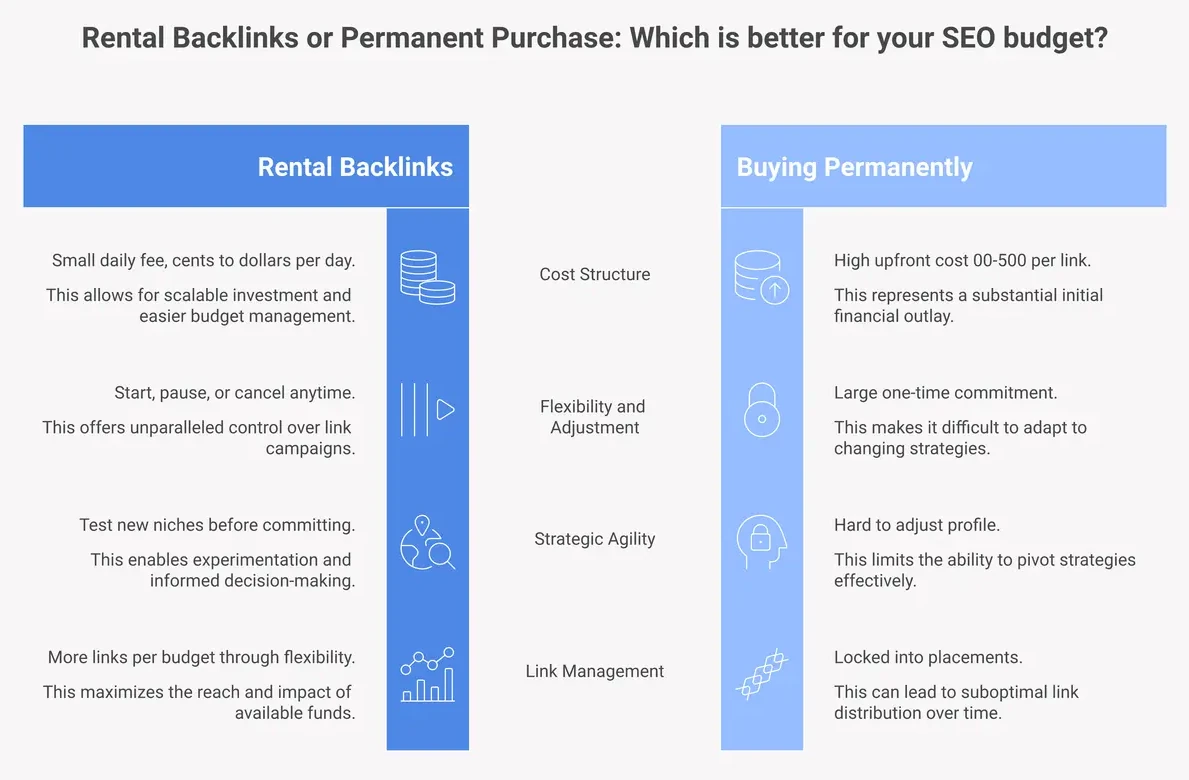
Rental backlinks are links placed on active websites for a recurring daily fee rather than a one-time upfront purchase. Instead of paying $100-500+ for a permanent placement, you pay a small daily amount while the link is active. This makes them the most budget-accessible paid backlink type available.
SEO value and flexibility
Rental backlinks carry the same ranking authority as purchased permanent links while they're active. The flexibility advantage is that you can adjust your link portfolio without losing sunk costs. Testing a new niche, running a time-specific campaign, or filling temporary authority gaps are all scenarios where rental outperforms buying outright.
When rentals make the most sense
Rental backlinks are ideal for Tier 2 campaigns, for maintaining consistent link velocity during a ranking push, and for budget campaigns where per-link cost needs to stay low. Our rental backlinks service offers daily billing with full flexibility to start, pause, or cancel at any time.
Why You Need a Mix of All Backlink Types
A backlink profile built from only one source type will eventually plateau or attract a penalty, regardless of the cost or quality of the individual links. Google evaluates the pattern across your entire profile, not just the individual links. A profile with 200 links all from the same source type looks like a deliberate campaign to a human reviewer and to a trained algorithm.
What a natural profile actually looks like
A site that earns links organically over time gets listed in directories, mentioned on professional platforms, cited in articles, linked from forum discussions, and occasionally referenced in startup communities. No single source dominates. The mix of types is the signal, not the total count. Our guide to building a natural backlink profile covers this in full detail.
The diversity rule in practice
A healthy profile includes at least 4-5 of the types above: a directory layer, some profile links, a few citation listings, maybe some web 2.0 support, and ideally 1-2 editorial or niche edit placements at the top. Understanding the different types of link building methods and using several of them together is the core principle. You don't need massive volume from each. A handful of links from each source type produces far better results than a large volume from just one.
How our link building service builds this for you
Our link building service builds campaigns that combine multiple types in one package: AI directories, general directories, profile pages, citations, and optional editorial placements. Every campaign uses gradual delivery that matches the velocity of organic link growth. If you'd rather outsource the entire operation, our outsource link building service handles everything from strategy to execution. Tools like MyLinksFlow let you track exactly which link types are driving rankings, so you know what's working in your specific niche.
100% free. No credit card required.
Frequently Asked Questions
What are the main types of backlinks in SEO?
The main backlink types are directory backlinks, profile backlinks, citation/NAP links, web 2.0 links, editorial/guest post links, niche edit links, tiered backlinks, and rental backlinks. Each type comes from a different source and carries a different SEO signal. Building a diverse mix of several types is what produces a natural-looking backlink profile that holds up under algorithm updates.
Which type of backlink is most powerful?
Editorial backlinks placed within high-quality content on relevant, authoritative domains carry the most ranking power per link. A single editorial placement on a trusted site in your niche can outperform dozens of directory or profile links. However, editorial links require the most effort or budget to acquire, which is why they work best as the top layer of a profile that already has foundational link diversity.
Are all types of backlinks safe for SEO?
All the types listed here are safe when used correctly and in proportion. The risk comes from over-reliance on one type or from acquiring links at an unnatural velocity. A sudden spike of 500 directory links from the same platform in one week looks manipulative even if directory links themselves are legitimate. Gradual, diverse link building is what stays safe across algorithm updates.
What is the difference between dofollow and nofollow backlinks?
A dofollow backlink passes PageRank from the linking page to your site, directly contributing to your domain authority and rankings. A nofollow backlink uses the rel="nofollow" attribute to signal that the link should not pass ranking credit. Natural backlink profiles contain both types: dofollow links build authority, while nofollow links from trusted platforms add brand signals and help the profile look organic.
How many different backlink types should a site have?
Most SEO experts recommend having at least 4-5 distinct source types in your backlink profile. The exact mix depends on your niche and competition level, but a strong starting point includes directory links, profile links, at least one citation layer, and 1-2 editorial or niche edit placements. Expanding the number of source types over time, rather than chasing volume from one type, is the safest long-term approach.